




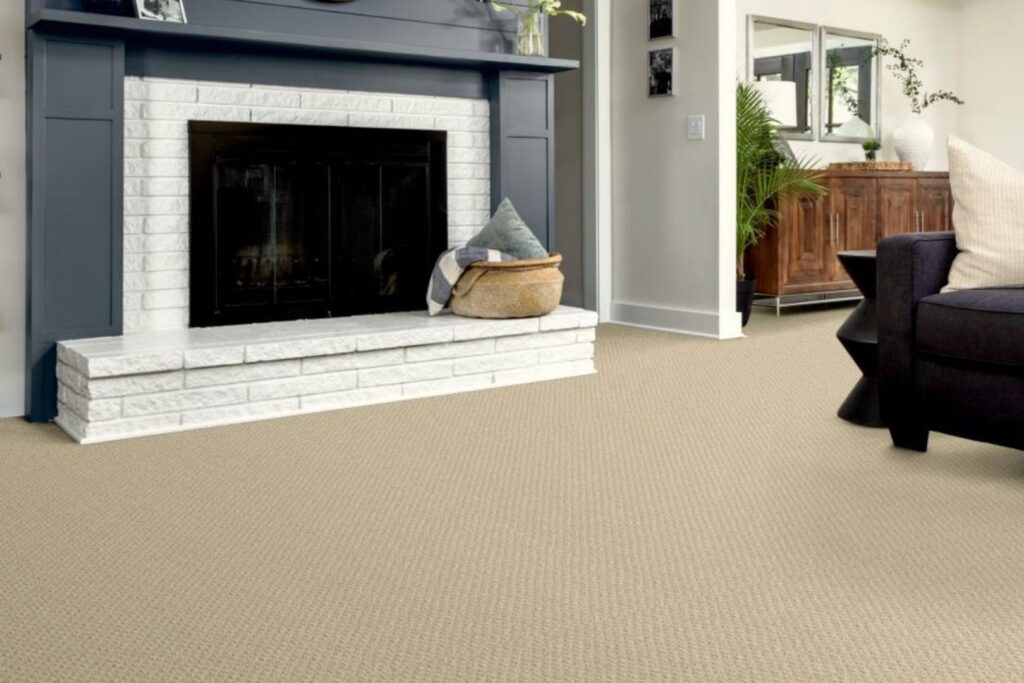
Does your floor still feel cold even when the heat is running? In mountain homes, the room can be comfortable at head height while the floor stays uncomfortable underfoot.
Carpet is the most direct answer to that problem, which is why it’s the flooring most often chosen for bedrooms and upper levels in Lake Tahoe and Truckee homes.
Not all carpet performs the same way. Fiber, pile construction, and the padding underneath all affect how warm a floor actually feels and how long it holds up.
Here’s which carpet fibers hold heat best, how pile and padding affect warmth, and what to consider before buying for a cold-climate home.
Why Does Carpet Feel Warmer Than Other Flooring?
Two things are happening at the same time, and they work together.
The first is insulation. Carpet and its padding trap air, and trapped air slows heat transfer, which helps the floor hold warmth rather than pulling it away.
The second is surface temperature. Hard surfaces conduct heat away from your foot faster than soft ones, so a tile floor and a carpeted floor at the same actual temperature won’t feel the same.
For a bedroom you walk into barefoot on a January morning, that difference is the entire point.
Which Carpet Fiber Is Warmest for a Mountain Home?
Fiber affects warmth, durability, and how the carpet handles the conditions in a mountain home.
Wool Carpet
Wool is a natural insulator and generally holds heat well. It handles humidity swings reasonably and tends to keep its appearance over a long period.
It’s typically the more expensive option and can be more sensitive to certain stains and cleaning methods than synthetics.
Nylon Carpet
Nylon is known for resilience, meaning it bounces back from compression rather than matting down in walkways. That matters in hallways, on stairs, and anywhere furniture sits.
It’s a common choice for households that want durability alongside comfort.
Polyester and Triexta Carpet
These are often selected for softness and stain resistance, which suits bedrooms and lower-traffic rooms well.
They may not recover from heavy foot traffic as well as nylon over time.
Olefin Carpet
Olefin is moisture resistant and sometimes used in basements or areas where damp is a concern.
It’s generally less resilient underfoot than the other options.
Which fiber makes sense depends on the room, the traffic it sees, and whether pets are in the picture, so it’s worth discussing against your actual spaces rather than choosing a category in the abstract.
How Do Carpet Pile Height and Density Affect Warmth?
Fiber is only part of the equation. How the carpet is constructed affects both how warm it feels and how well it wears.
- Carpet density matters more than pile height: A dense, shorter pile often insulates better and wears better than a tall, sparse one. Density refers to how closely the fibers are packed.
- Cut pile carpet feels softer underfoot: Styles such as plush and frieze are common choices for bedrooms.
- Loop and patterned carpet handles traffic: These show footprints less and hold up well in hallways and on stairs.
- High pile carpet involves tradeoffs: It can feel luxurious in a bedroom and is harder to keep looking good in a high-traffic area.
Does Carpet Padding Affect How Warm a Floor Feels?
Yes, and padding does a substantial share of the insulating work. It’s also the part most people don’t think about when they’re choosing carpet.
Thicker padding isn’t automatically better. Padding that’s too soft or too thick for the carpet can allow the carpet to flex more than it should, which may shorten its life. Many carpet manufacturers specify a padding range for their products.
If warmth is your priority, ask about carpet padding directly rather than defaulting to whatever comes standard. Options vary in density and in how they perform over radiant heat.
Can You Install Carpet Over Radiant Floor Heating?
Yes, and radiant heat is common in mountain construction.
The consideration is that carpet and padding both slow heat transfer, which is the same property that makes them feel warm in the first place.
Systems are typically designed with the floor covering in mind. If you’re putting carpet over existing radiant heat, or planning both at once, that’s a conversation worth having before the order is placed rather than after.
What Should You Consider When Choosing Carpet for a Tahoe Home?
A few conditions specific to this area affect how carpet performs and how long it lasts.
- Entry points: Grit and moisture tracked in from snow and gravel are hard on carpet. Durable surfaces at entries with carpet beyond them is a common approach.
- Stairs: Stairs take concentrated wear, and a dense, lower-pile construction usually holds up better. Stair runners are another option worth asking about.
- Second homes and vacation rentals: A property that sits empty between visits, or turns over frequently, has different durability and cleaning requirements than a primary residence.
- Pets: Fiber choice, pile construction, and backing all factor in.
- Seasonal dryness: Indoor humidity drops considerably when heating runs for months, which can affect static and how some materials behave.
How Do You Choose Carpet for a Mountain Home?
Narrowing the options goes faster when you start with the rooms rather than the product.
- Identify the cold rooms: Which spaces are uncomfortable, how they’re used, and who walks through them narrows the field quickly.
- View carpet samples in your own light: Carpet reads differently in a showroom than in a room with mountain light and tall windows.
- Specify padding with the carpet: The two are selected together, and the pairing affects both feel and lifespan.
- Confirm measurements and lead times: Material availability and installation scheduling both vary, which matters if you’re working toward a date.
- Plan the carpet installation: Furniture moving, subfloor condition, and transitions to adjoining flooring are all worth settling in advance.
Frequently Asked Questions About Carpet for Mountain Homes
What Is the Warmest Type of Carpet?
Wool is a natural insulator and generally performs well for warmth. Beyond fiber, a dense pile paired with appropriate padding does much of the work, so construction matters as much as the material itself.
Is Carpet or Luxury Vinyl Plank Better for a Cabin?
They serve different purposes. Carpet is warmer underfoot and better suited to bedrooms and upper levels, while luxury vinyl plank handles moisture and tracked-in grit better in entries and high-traffic areas. Many mountain homes use both.
How Much Does Carpet Cost per Square Foot Installed?
Installed carpet cost depends on fiber, construction, padding, and the complexity of the space, including stairs and transitions. An in-person measurement is the reliable way to get an accurate figure.
Does Carpet Help Reduce Heating Costs?
Carpet and padding slow heat transfer through the floor, which can help a room retain warmth. The effect varies with the construction of the home and the type of heating system.
Find the Right Carpet With Tahoe Specialty Flooring & Window Design in Tahoe City & Incline Village
If cold floors are the problem you’re trying to solve, our team at Tahoe Specialty Flooring & Window Design can help you choose a carpet suited to your rooms and your climate.
We carry carpet alongside our other flooring and window covering lines, and we can walk you through fiber, pile, and padding options in person.
Proudly serving homeowners throughout Lake Tahoe, Truckee, Incline Village, and the surrounding communities, we’re here to help you get the rooms right the first time.
Don’t spend another winter on cold floors. Contact Tahoe Specialty Flooring & Window Design or visit our Tahoe City or Incline Village showroom.